APEC Blog

The APEC team is here to be your number one resource regarding all automated processing topics. Explore our blog posts below to learn more.

7 Most Common Foodborne Illness Risks in Your Food Processing Plant

A variety of bacteria and viruses, including Norovirus, Salmonella, Clostridium perfringens, E. coli, and Campylobacter, among others, can infect food, causing thousands of illnesses and deaths every year. These pathogens can hide in many different materials, usually originating from infected water or soil. The sheer…
Read More

8 FSMA Food Safety Risks Processors and Manufacturers Must Know

The Food Safety and Modernization Act (FSMA) created stricter food safety rules for farmers, growers, and food processors of all kinds. Compliance means preventing or dramatically reducing the chance of contamination, while non-compliance can result in FDA fines, consumer illnesses, and legal battles. Process design,…
Read More

Improving Accuracy in Automated Processing Systems: Finding the Right Load Cell

Automated systems have made food, pharmaceutical and chemical processing systems faster and more efficient. An important part of this process is the accurate weighing of ingredients. As ingredients have become more concentrated, the importance for highly accurate scales has increased. The challenge for many engineers…
Read More

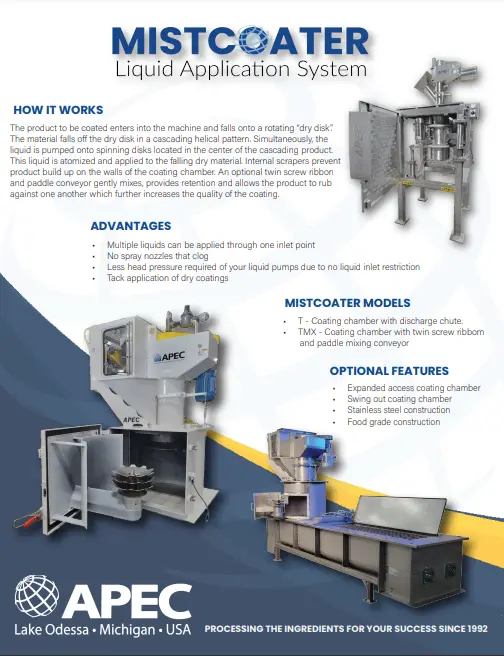
Liquid Coating Processes for Uniform Snack Coating

Whether for flavor, vitamin content, shelf life, or texture, liquid coating is the preferred application method for many cereals, snacks, pet food mixes, and more. Though this provides a number of efficient, time-saving advantages for snack coating, it can introduce some challenges if the process…
Read More

Part 1: Ingredient System Planning Pitfalls from Micro-Ingredient Bins to Feeders

Proper planning before an ingredient system redesign or new installation is pivotal to ensure the system runs efficiently.  With so many moving parts and considerations, it’s not easy to plan for every eventuality, and a few problems are consistently missed. In this blog post, we’ll…
Read More

How to Optimize Your Ribbon Mixer

Ribbon mixers in many industries are designed similarly from facility to facility with few variations. However, some design considerations can minimize the up front investment and maintenance, and maximize production and quality. The best way to get optimal efficiency from your ribbon mixer is to…
Read More

Complete Ingredient Mixing Systems Design Checklist

There is no one-size-fits-all for ingredient mixing systems design, whether you are working in snack foods, animal feed, dry bulk solids or any other industry. Ingredient mixing system designs require careful consideration of all ingredients as well as production schedules, variation, storage and more. In…
Read More

18 Batch Mixing System Design Considerations for the Best Dry Solids Mix

[vc_row][vc_column][vc_column_text css=""]Producing high-quality finished products from dry solids starts with getting the right mix. Dry mixing machines are not one-size-fits-all, and your batch mixing system must be designed with your ingredients, facility, capacity, and other considerations in mind. Without the right mixer, segregation problems, dead…
Read More

Solving Material Segregation in Batch Mixing Processes

When solid materials mix, a degree of material segregation is inevitable. A variety of processes are used to achieve a predetermined level of uniformity in batch mixing processes, however other processes downstream can cause the materials to separate again. With proper design considerations and awareness…
Read More